Every time we make a big announcement, we start by restating our mission: to improve the practice of reading through software by an order of magnitude.
One thing we've never shared, however, is our so-called "super secret master plan." It's been our long-range roadmap for how we might pull off such an ambitious-sounding mission despite being a bootstrapped company without the benefit of external funding.
Our plan goes like this:
Step one. Build a niche product that solves a problem so deeply that high- expectation readers would be willing to pay for software. We did this starting as a team of two founders in 2017 with our original product, Readwise, renamed as of today to Readwise Highlights.
Step two. Reinvest the revenue, learnings, and relationships from step one to move into the digital reading experience itself. We did this too, as a larger team, with our second product, Readwise Reader.
Step three. Continue reinvesting the revenue, learnings, and relationships from previous steps to break into the slow-moving and high barrier-to-entry ebook market. This third and most ambitious step is what we're excited to share today.
We've built Readwise Books: our very own ebook store and app. In simple terms, you can think of it as a cross between the Kindle and Goodreads apps, where you can buy, read, and track books. But of course there's much more to it than that.
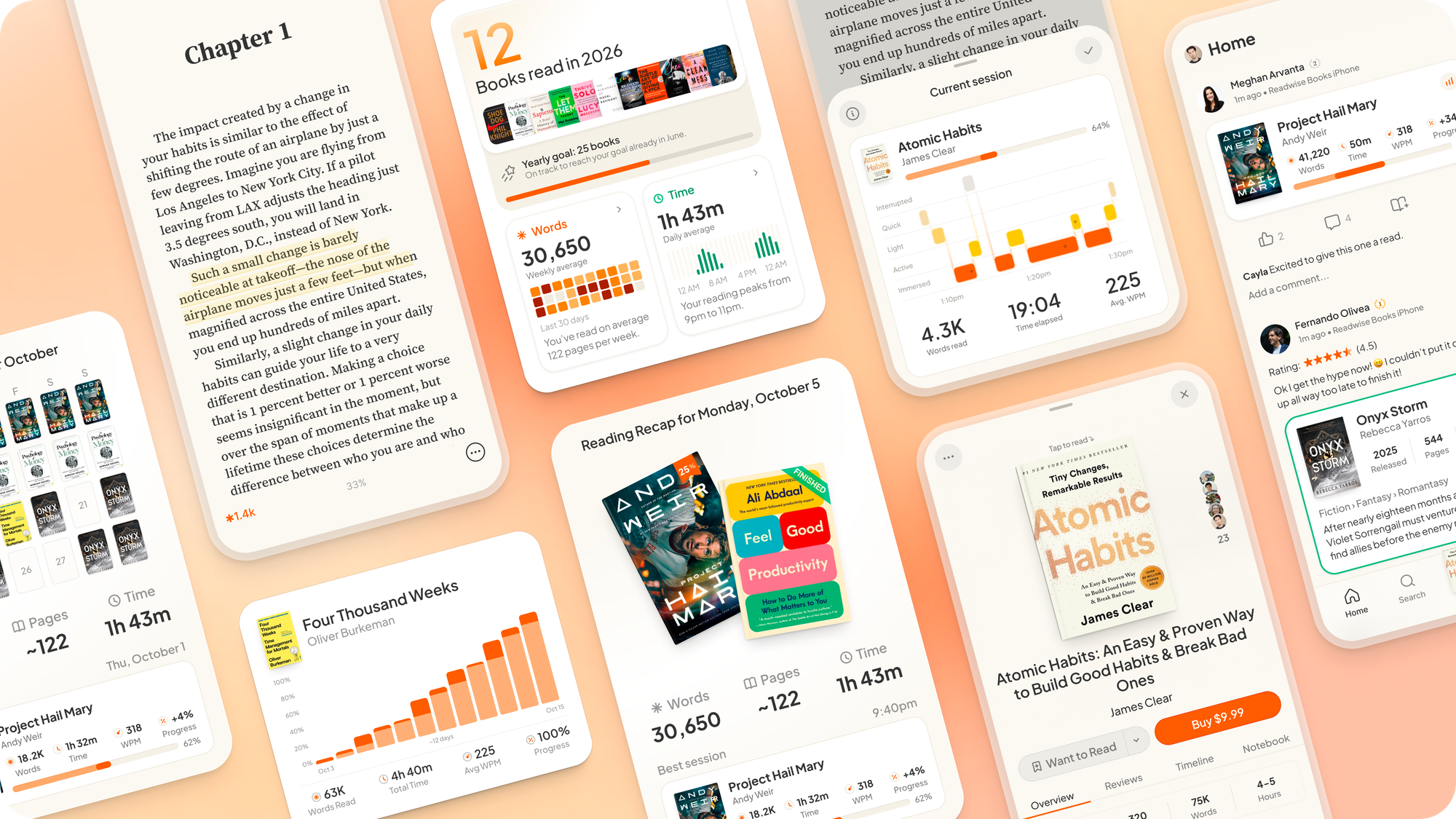
This post describes Readwise Books in detail, and why you might use it over the incumbent alternatives, but in short, Readwise Books is...
- An independent bookstore. Readwise Books is the first truly independent, digital-first challenger to credibly enter the ebook market with millions of ebooks for sale, including all those from the Big 5 publishers and then some.[^1] Stated differently, none of the big tech or big book incumbents seem to care about ebooks any more, and there hasn't been any real product innovation in years. Meanwhile, we are a small nimble team who loves the heck out of books, listens to user feedback to iterate quickly, and wants to make the best digital reading experience in the world. Now we can!
- A one-stop shop for reading and tracking. The foundation of the app is a unified experience where you can not only read purchased or uploaded ebooks like Apple Books, but also track them like Goodreads, all in one place.
- The Strava of reading. The core innovation is a whole new dimension of tracking your reading on the session level, automatically. You can think of this like tracking a run, a workout, or your sleep, and the benefits are similar: it subconsciously helps you both read more and read deeper without relying on willpower-based tactics.
- A novel social experience. The session innovation also sets up a light social component that's designed to feel less like a new social network and more like reading a book in your favorite coffee shop or library. This is a phenomenon we now know is called ambient co-presence, and it compounds the benefits of the single-player session tracking.
- Optimized for Android e-readers. While ebooks offer many advantages over print books, many readers simply do not wish to read on their phones. Fortunately, a new generation of Android-based e-ink devices has emerged in the past few years such as Onyx BOOX and Daylight Computer, and Readwise Books is designed to run seamlessly on those out of the box.
- Fully loaded. Finally, Readwise Books is chockfull of powerful features including an elevated reading experience, best-in-class highlighting & note-taking, third-party integrations, manual session tracking for reading outside the app, a public API and MCP server for your agents, text-to-speech and LLM-powered features for uploaded ebooks, and a tight integration with the broader Readwise ecosystem. You can expect the platform to continuously evolve from here.
If you'd rather try it than read about it, Readwise Books is now in both the iOS and Android stores. You'll need an invite code during this beta phase, but if you're an existing subscriber, you have immediate access using your Readwise account. For everyone else, we plan to publicly release before the end of the year.
If you want to go deeper, the rest of this post explains:
- Why we're building Readwise Books, and why now
- What Readwise Books does, and what makes it special
- How the Readwise ecosystem is evolving, and how all three products will grow together
Let's get into it.
1. Why we're building Readwise Books, and why now
The simple reason is that something like Readwise Books is what we've always intended to do. Our vision from the beginning has been a world where ebooks are thriving due to innovation rather than stagnating due to neglect, and we believed the digital reading landscape would benefit from more product-first players like us.
But that explanation is both uninteresting and uninspiring. To go deeper, let us start answering "Why now?" by addressing: "Why not several years ago?" After all, as we just said, something like Readwise Books has been the vision from the beginning.
Why not build Readwise Books earlier?
We couldn't jump in sooner, at least not with any reasonable odds of success, because one does not simply walk into the ebook market. Below are just some of the challenges facing anyone who dares to enter.
It's high barrier-to-entry. A new player needs to strike complex deals with each and every one of the big trade publishers (including Penguin Random House, HarperCollins, Simon & Schuster, Hachette, and Macmillan, collectively known as the "Big 5"), stand up a bookstore carrying millions of idiosyncratic products, and deliver a consumer-grade software experience.[^2] Even with perfect execution, you're looking at years of business and software development and millions of dollars of investment just to get a seat at the table.
It's small. Credible figures are hard to come by, but our best internal estimate is that the ebook market, excluding self-publishing, does about $3 billion in gross sales per year in the United States. Even if you include audiobooks and the global market, digital books likely generate only $10 billion to $15 billion in gross sales per year. Keep in mind: this is low-margin retail revenue with little to no growth trend. To put this in perspective, Anthropic, OpenAI, and Google Cloud are each adding more annualized revenue in a single quarter than the entire global digital book market generates in a year.
It's dominated by powerful incumbents. On one side of the table you have the big tech players like Amazon, Apple, and Google. On the other, the big book players like Barnes & Noble and Kobo. Not only are these companies big, they have virtually every competitive advantage (or "moat") a student of business strategy could wish for. Switching costs, through proprietary hardware lock-in and content lock-in. Network effects, through scaled publisher deals, self-publishing marketplaces, and user-generated ratings and reviews. And entrenched distribution channels, like the operating systems on billions of mobile devices, networks of physical stores, and the go-to online directory for books.
It's structurally constrained. There's little freedom to escape the competition for market share by creating a so-called blue ocean. For example, you can't build a "Netflix of books" with mainstream titles (many have tried), because the big publishers won't license them on terms that make economic sense. Creating new business models is neither our desire nor our specialty, but even in our own domain of product innovation there's little whitespace for creativity, because license restrictions forbid many of the obvious ideas. As a timely example, any feature involving large language models is subject to significant scrutiny and approval processes.
This punishing gauntlet begins to explain why there are so few new entrants into the ebook market, and why it took us so many years to get here.
Fortunately, we're happy to share that after several years of effort, we've now overcome the upfront barriers to entry. We have distribution deals with all of the Big 5 publishers, we've stood up the bookshop, and, as we'll get into soon, we've built a compelling product. Many challenges still lie ahead, but we've done all of this as a sustainable business that can survive in a small market rather than relying on the promise of capturing x% of the market to raise the next round of funding.
This means, as far as we know, Readwise is the only truly independent, digital-first challenger to credibly enter the ebook market, ever.[^1]
An exciting milestone, no doubt, but enough about our odyssey. Let's now look beyond ourselves and into the (near) future.
Why is now the right time?
This is the point in a manifesto-like announcement where we're supposed to point out that (a) reading is inherently good for us, both as individuals and as a society, but (b) reading is, by all accounts, in a free fall, and (c) our new product is the solution to this problem. This is such a tired pitch that we'll spare you the clichéd version. Instead, let us share a fresh take by pointing out a seemingly unrelated trend that we believe will reverse the reading free fall and, hopefully, bodes well for the timing of Readwise Books.
In most commentary about the downfall of reading, the standard remedy is some prescription of less smartphone, more print books. We get that, and we certainly believe most people would be better off if they were less addicted to staring at their screens. But we also don't believe that simply reminding people "screen time bad; reading books good" will change behavior. Our view is that inspiration, rather than shame, is a far more potent motivator.
Along these lines, there's a powerful movement that's gained momentum since we started Readwise, and we believe it has the potential to inspire a whole new generation of readers. The trend is now so pervasive that many consumers are even ranking it as a top life goal ahead of things like family and friends, finances, or careers.
That trend is health and wellness.[^3]
To see the connection, consider how one practice after another, whether physical or mental, has crossed the chasm from fringe curiosity to mainstream wellness movement over the past two decades.
Resistance training. Meditation. Cold plunges. Sauna (Finnish and infrared). Sleep tracking. Zone 2 cardio. VO2 max. Recovery. Ten thousand steps a day. Closing your rings. Standing not sitting. Continuous glucose monitors. Light exposure. Light blocking. Weighted vests. Creatine. Protein. Protein powder (whey post-workout, casein before bed). Nootropics. Neurotransmitters. Nicotine pouches. Breathwork. Talk therapy. Mobility. Fascial release. Mouth tape. Nasal strips.
That reads like the lyrics to a Radiohead song, but we're guessing you've partaken in more than a few of those once-fringe pursuits. We know we certainly have.
But what age-old practice, already known to benefit one's mental well-being, is conspicuously absent from the wellness conversations to date? Reading books, of course.
Viewed through this lens, it's downright surprising that reading isn't already discussed in the same breath as sauna and sleep tracking. For starters, the scientific evidence in favor of reading's impact on wellness is substantial. Here are just some of the benefits above and beyond the inherent entertainment and betterment value of books:
- A study published in the New England Journal of Medicine followed 469 adults over 75 for five years and found that frequent readers were 35% less likely to develop dementia than infrequent ones.
- A Yale study in Social Science & Medicine followed 3,635 adults over 50 for twelve years and found that those who read more than 3.5 hours a week were 23% less likely to die. Put in pithy terms, a chapter a day keeps death away (for about two extra years).
- A Rush University study in Neurology followed 294 older adults until death and found that the most mentally active among them, with reading chief among their activities, showed 32% slower cognitive decline than their average peers.
- A New School study in Science randomly assigned people to read a few pages of literary fiction, popular fiction, nonfiction, or nothing, and found that the literary fiction readers were better at judging emotion from photographs of strangers’ eyes, a standard test of theory of mind and the basis of empathy. (Although this empathy claim is the most debated science of the bunch.)
Given everything going on with artificial intelligence, we also see a historical precedent suggesting this reframe is imminent. It's hard to believe, but not too long ago, "working out" wasn't even a thing. People simply got their workouts at... work. Then much of manual labor was automated away, giving rise to office jobs, sedentary lifestyles, and then aerobics. Now machines are coming for cognitive labor, and it won't be long before the need to exercise our minds is as commonplace as getting 10,000 steps per day. And reading, especially reading in long, unbroken stretches, is the oldest, cheapest, and best-evidenced way to do just that.
Reading simply hasn't had its wellness moment yet, but we're betting it's close. When it comes, we're optimistic the secular downtrend in the time adults dedicate to books will reverse. Not because "smartphone bad," but because the wellness movement has proven, at scale, that ordinary people will do hard things like lifting heavy objects, sitting in ice water, and going to bed on time, as long as the behavior comes with a bit of science, a number to track, and other people doing it alongside them.
As for our role in all this, we're participating the only way we know how: through product innovation. Judged as just another book app, some of what follows next about Readwise Books might look strange. Seen through the wellness lens, we think every piece will make sense.
2. What Readwise Books does, and what makes it special
When most readers hear the term "book app," they typically think of either (a) a book platform like Apple Books, where you buy and read ebooks, or (b) a book tracking app like Goodreads, where you track what titles you've read, want to read, and are currently reading. The first unique thing about Readwise Books is that it does both, in one unified experience.
In typical Readwise fashion, we've also schlepped together difficult integrations making it easy to bring in your existing data and start tracking all your books in one place, whether they're ebooks, audiobooks, or print. You can do this today with Goodreads and Kindle, but more are on the way.
This one-stop shop sets the foundation of Readwise Books, but it's not particularly innovative in the sense of doing things that have never been done before. That leads us to the second unique thing about Readwise Books, and its core innovation: it opens up an entirely new dimension of advanced reading session data, similar in many ways to tracking a run, a workout, or your sleep. We refer to this internally as the Strava of Reading.
The Strava of Reading
In a standard book tracking app like Goodreads, you track at the book or shelf level. When you hear about a book you might want to read someday, you put it on your "Want to Read" shelf. When you start reading a book, you move it to your "Currently Reading" shelf. When you finish, you give it a rating, sometimes write a review, and move it to your "Finished" shelf. When you abandon, you move it to your "Did Not Finish" shelf (a feature recently added to Goodreads a mere nineteen years after the service first launched). Tracking at the book level also means you can do things like prepare "to be read" lists and complete annual reading challenges.
You can do all this in Readwise Books too, but the app also tracks the practice of reading itself. Every time you flip the page, the app logs how many words you read and for how long, the same way a pedometer automatically counts how many steps you've taken. These events then roll up into a reading session, the atomic unit of Readwise Books.
For some readers, this feature is an end in itself and needs no further translation into benefits. Nassim Taleb, for example, explains in Antifragile: "I started around the age of thirteen, to keep a log of my reading hours, shooting for between thirty and sixty a week, a practice I've kept up for a long time." For others, the value of this session tracking might not be immediately obvious.
We’re still discovering all the benefits unlocked by this data, but here are three our users already love.
It's positively motivating. The desire to read books, like exercising and eating well, is laden with guilt. Many people feel like they should be reading more, but feeling bad about it tends to change nothing. The session tracking taps into a different psychological mechanism. It makes the reading you're doing legible and, as the adage goes, that which is measured is improved. This isn't merely theoretical: the most consistent feedback we hear from our users is that Readwise Books has led them to read more, naturally, without the need for willpower-based mechanisms such as goal-setting, streaks, or scheduling. For example, you might find yourself choosing to read for ten minutes instead of doomscrolling while waiting in line, because now those ten minutes count for something.
It deepens your practice. Beyond reading more, the session tracking helps you read better. For most people, "better" typically means achieving longer and deeper stretches of focused attention. It's similar to wearing a heart rate monitor during cardio to stay in a particular zone. Instead of relying on metacognition to push yourself, the heart rate number becomes your guide. In the same way, the session data creates a feedback loop that helps you deliberately train your attention.
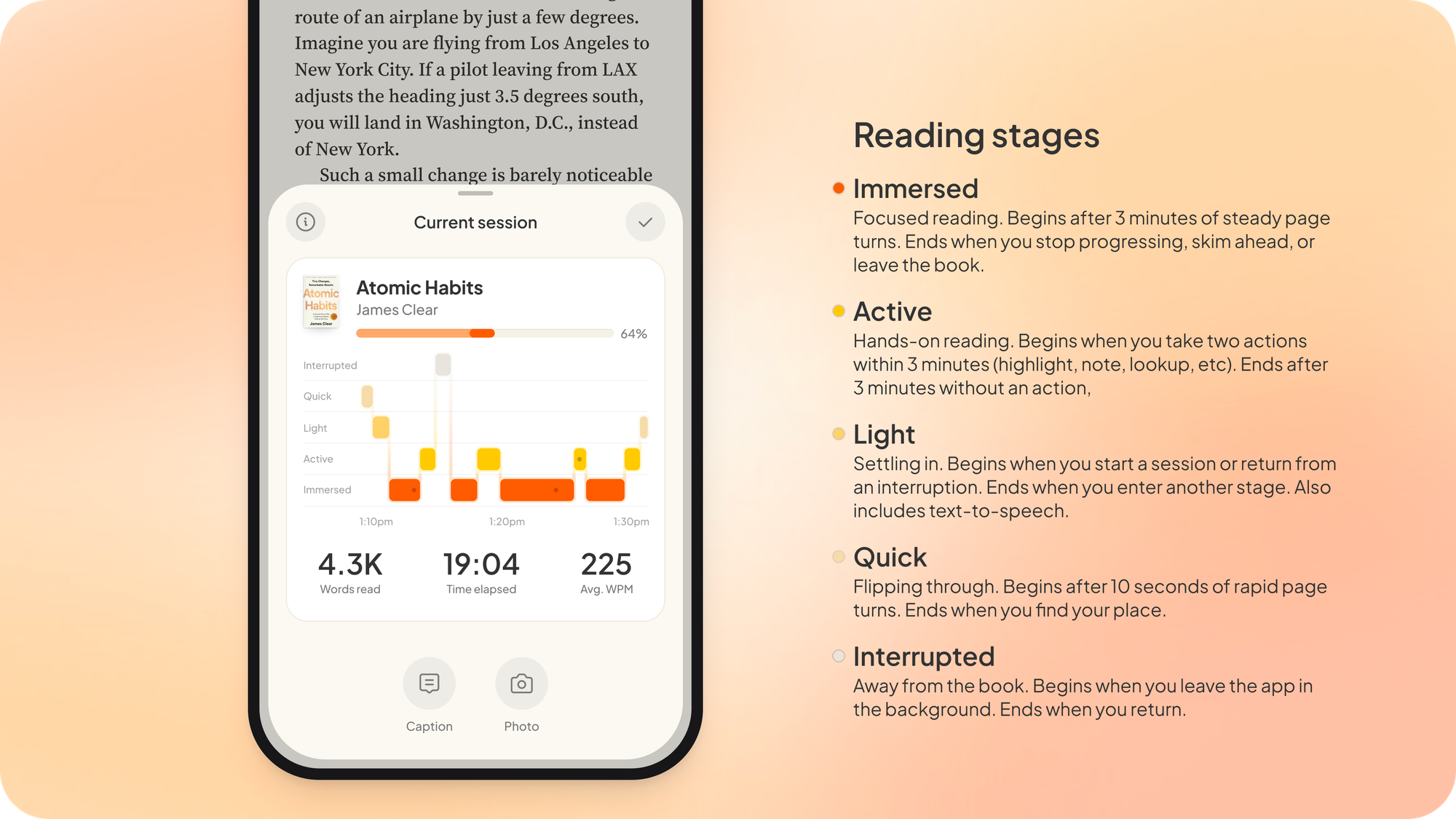
It becomes a keepsake. One downside of digital reading compared to print is the lack of a tangible artifact. The ebooks you've read vanish into a grid of tiny covers on a screen. There's no object to stack, no bookshelf to walk past, and no cue to remind you of a particular story or idea you once encountered inside a book. Many readers use an app like Goodreads to get some of this back. The session data of Readwise Books goes several steps farther. For example, you can now visualize your journey through every book you've read, and weeks, months, and years of reading roll up the same way.
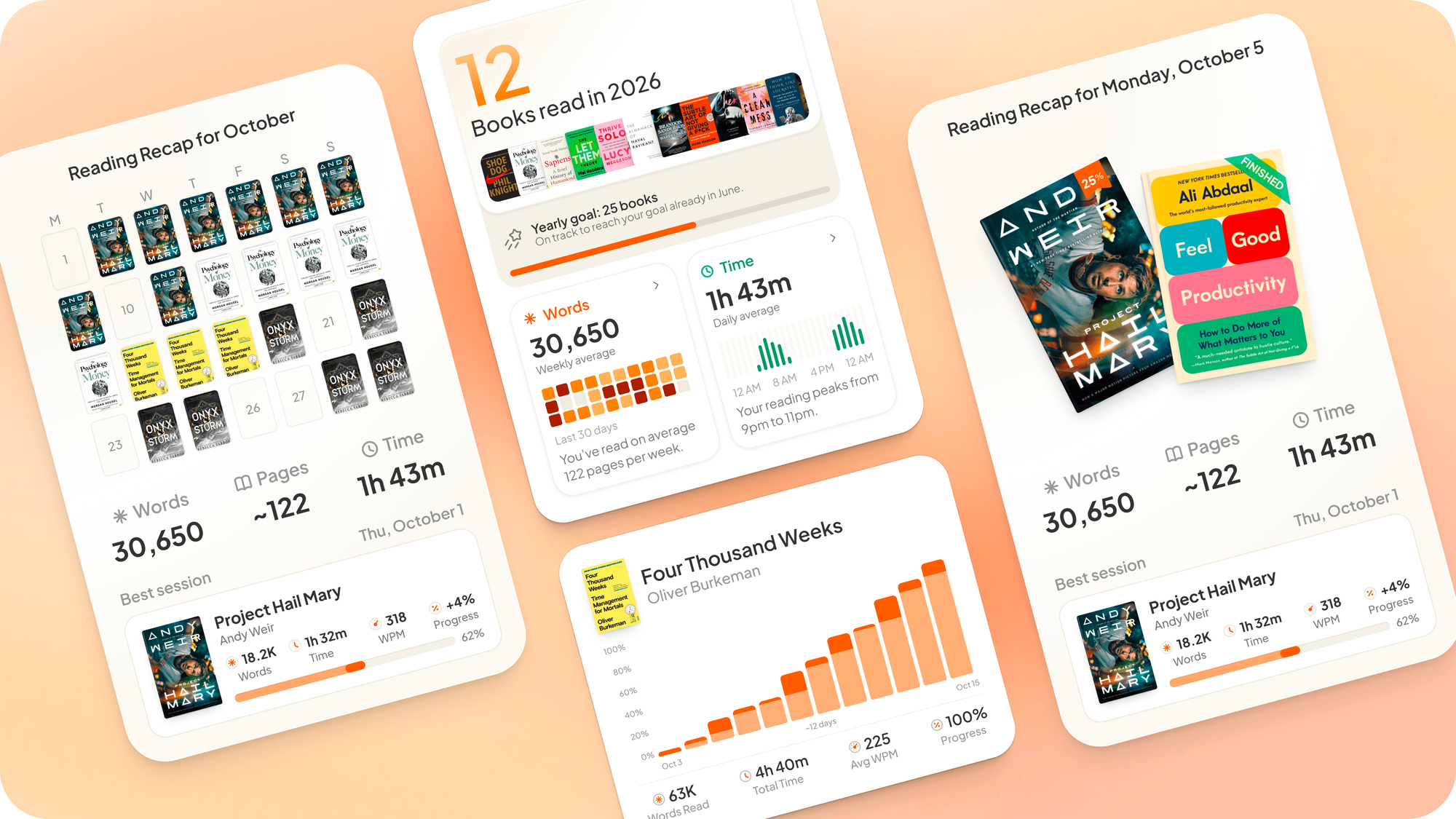
The reading session also creates the raw material for a new type of social network, which is the third, and most surprising, thing that makes Readwise Books unique.
Reading alone is better, together
Like many of you, we've always been skeptical of so-called "social reading." If you'd told us two years ago that Readwise Books would end up with a social component, we'd have scoffed and pointed out that the phrase is basically an oxymoron. But once we had the wellness frame and Strava metaphor, the product was inexorably drawn in this direction.
Our aversion to attempting yet another consumer social network faded quickly, though, once we sensed that what was emerging was nothing like social media. In no way does the social in Readwise Books feel like a platform where a minority creates content for the majority to consume. Instead, it triggered a behavior where users engaged more deeply in their own reading simply by being around others doing the same. We later learned the phenomenon has a name: ambient co-presence.
Have you ever found yourself enjoying reading more at a coffee shop? Or a university library? Or on a park bench? That's ambient co-presence.
Maggie Appleton described the concept best in her essay of the same name: "the sensation of sharing a space or context with other people, without directly interacting or continuously communicating with them." Her first example of ambient co-presence is literally reading: "quietly reading on the back porch with family, sitting in a cafe full of people softly chatting or tapping away at laptops." The others "rarely demand your attention or strike up conversations. They just exist nearby, unobtrusively doing whatever they're doing. Providing companionship, comfort, and small windows of insight."
This is how we think about the social layer in Readwise Books. Your sessions post to a light feed (unless you don't want them to) where the people who follow you can see that you're reading. It's not about performing for likes, or running a book club, but simply existing in the proximity of other like-minded readers where the only engage-bait is someone else's session. And just like Strava, occasional interactions with a supportive community add to the positive feedback loops.
If none of this seems interesting to you, you can of course go private and read alone. We're toolmakers by trade, so Readwise Books is designed at its core to deliver the best reading and tracking experience out there.
With single-player mode in mind, let us share some other features of Readwise Books starting with one of the most common objections we hear: "I don't want to read on my phone or iPad. Will it work on an e-reader like my Kindle?"
Optimized for Android-based e-readers
Ever since we started Readwise, the lack of an e-reading hardware solution has been one of our chief long-term concerns. We've since been surprised by how many users are happy to read books on their phones, but for many digital readers (including most of our team), it's inconceivable.
Until recently, the only real e-ink options were vertically-integrated players like Kindle and Kobo who control the entire hardware, firmware, and software stack and do not allow third parties like us to build apps on their platforms. Fortunately, the landscape has shifted. There's been a Cambrian explosion of new, innovative, and open e-ink devices created by companies such as Onyx BOOX and our friends at Daylight Computer.
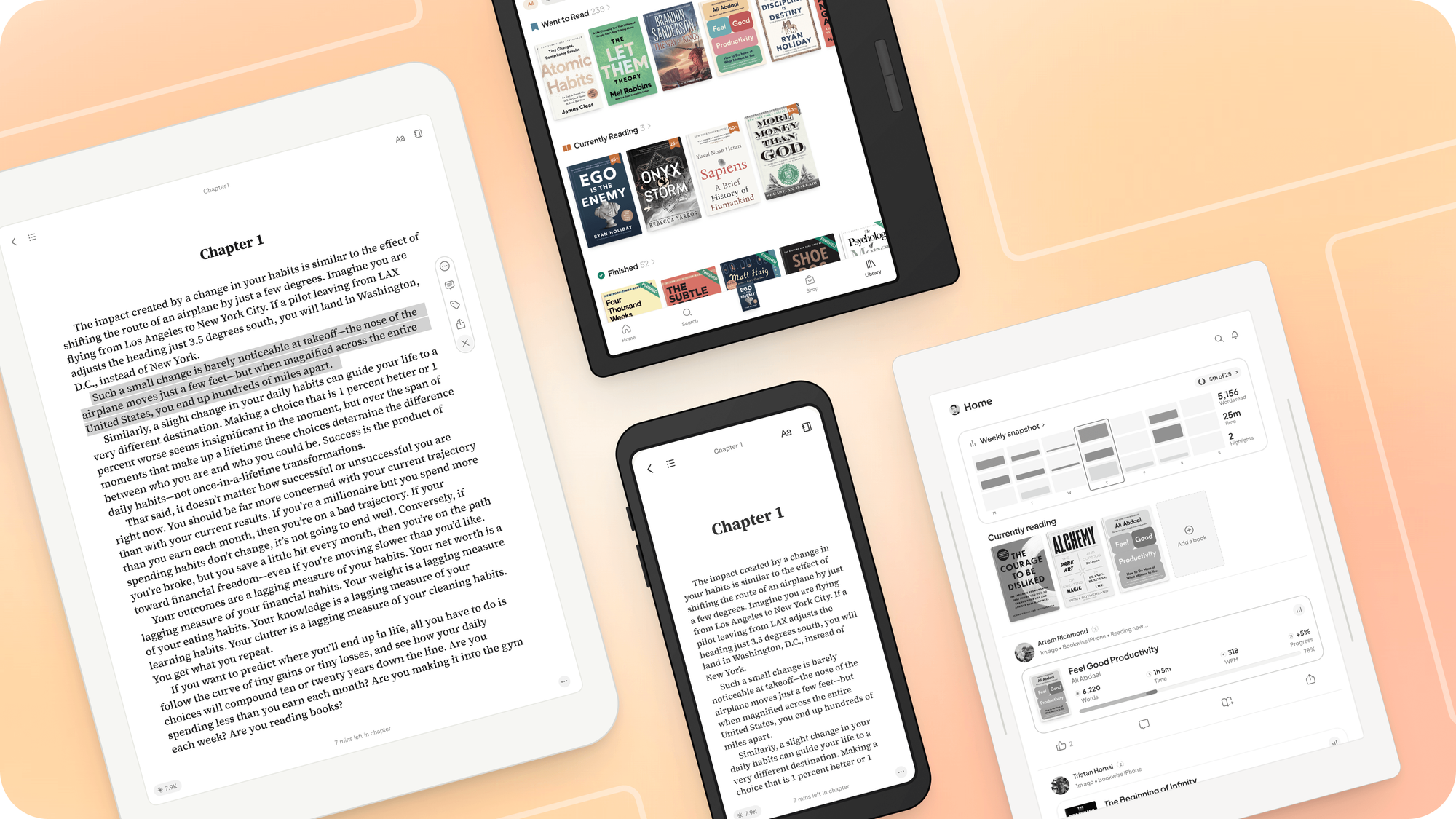
These devices all run Android, so you can install and enjoy Readwise Books on them out of the box. And you can be assured we put much care into this experience because every member of our team reads on one.
This shift is so significant that we considered putting it in the "Why now?" section above. Beyond giving us an e-ink solution, it's a perfect case study in how consumers benefit when a high barrier-to-entry market opens up to smaller, nimbler players. We now see innovation and choice along all kinds of interesting vectors that didn't exist before. There are new form factors, such as the wildly popular, phone-sized BOOX Palma and the even tinier breakout success Xteink S4. New color and backlighting options. High frame rate, iPad-like options such as the Daylight Computer. Tactile page flip buttons. Keyboards. Stylus support. Hackable firmware by design. And probably much more to come.
As of right now, these devices are admittedly geared toward early adopters who are willing to buy a new gadget and do a little fiddling. But at the rate they're advancing, we fully expect to be recommending these to our mothers soon. Who knows? Maybe we'll even partner on one, or someday make our own.
The rest of Readwise Books
In addition to the unique features above, Readwise Books comes loaded with several other notable capabilities, which we'll briefly touch on below.
Independent bookshop. Although mentioned throughout, let us be clear that Readwise Books is not only a reading and book tracking app, but also a full-fledged digital bookshop with millions of ebooks from all the Big 5 publishers and several others. As of this announcement, these books are only for sale in the United States, but we'll be expanding to other territories as soon as possible. Although this post has been focused on ebooks – our specialty – it's also worth mentioning that our bookshop carries both print (fulfilled by the same distributor as Bookshop.org) and audiobooks as well. We'll be incorporating these formats more deeply into Readwise Books over time.
First-class reading & highlighting experience. We've been building reading software for nearly a decade, and much of that experience went into Readwise Books. Highlighting, note-taking, and tagging are first-class features, as you'd expect from us, with attention to details such as smoother highlighting across pages, the first-ever ability to highlight a book sample, and highlights automatically enhanced with chapter metadata. There are also all the typography settings you'd expect, light and dark modes, various reading themes, pagination and continuous scroll, and multiple progress indicator options.
Kindle Cloud Reader support. Publishers require restrictions on ebooks (known as digital rights management or "DRM") meaning, among other things, that you can't transfer an ebook purchased in one platform to another.[^4] In other words, you can't import your Kindle ebooks proper and read them natively inside Readwise Books. That said, we've built an integration that enables you to quickly pull in your Kindle books to be tracked at the shelf-level. You can also track your reading sessions on these Kindle books provided that you read them inside Readwise Books using Kindle's browser-based Cloud Reader. We plan to add more of these integrations with other platforms over time.
Manual session tracking. For your reading outside Readwise Books, you can use the app as a reading companion to log your print book, audiobook, and non-Readwise ebook sessions by hand. You won't get the same high-fidelity data you'd get automatically by reading an ebook, but you will get the high-level stats, including words read, time read, and progress. You can also highlight these books using your phone's camera and add comments to manual sessions while you read.
EPUB uploading. In addition to buying ebooks from our bookshop, you can also upload any DRM-free EPUBs you already own so you can read, highlight, and track them inside Readwise Books. Unlike the DRM-protected ebooks where publishers impose various restrictions, uploaded ebooks also work with certain text-to-speech and AI features, each described below.
Free forever. As with any ebook platform, you need to buy the ebooks you want to read (or upload your own), but using the app itself is free. That said, we expect the next two features – text-to-speech and AI on uploaded books – will eventually become part of a premium membership option. While we're in beta, they're included for everyone.
Assistive Reader (text-to-speech). You can listen to uploaded ebooks using high-quality, lifelike voices. The text follows along as it's read aloud, so you can switch between reading with your eyes and listening with your ears without losing your place. Or you can both read and listen at the same time, sometimes referred to as "immersion reading", which helps some readers stay locked in.
Ghostreader (AI-enabled features). AI is a bit of a lightning rod issue, so let us start with a disclaimer: we take an extremely cautious stance towards any application of AI with books. For example, we seek publisher permission rather than forgiveness, we focus on features intended to enhance rather than replace the fundamental reading experience, users have the ability to toggle each of these on or off, and (we hope this goes without saying) we do not train large language models. That being said, Readwise Books does incorporate some LLM-powered features for uploaded ebooks and publishers who opt in.[^5] These include session recaps, dictionary definitions, term lookup, word & phrase translations, and the location-aware ability to ask a question while you read.
First-class API and MCP server. Your reading data is yours, and the public API and MCP server make it easy for power users to explore all kinds of imaginative use cases. You can get an agent to research book recommendations based on your reading history and add them straight to your Want to Read shelf. You can create a "books" page on your personal website with no backend. You can put your reading data next to your sleep and biometrics to see how they move together. You can wire your hackable e-ink device to Readwise Books to log sessions. The possibilities are endless.
Integrated with the Readwise ecosystem. Last but not least, Readwise Books is fully integrated with the rest of Readwise. One account is shared by Readwise Books, Reader, and Highlights. This means any highlight you make in Readwise Books instantly syncs to Highlights. Any EPUB you upload to Reader appears in Books. And more to come.
3. How the Readwise ecosystem is evolving, and how all three products will grow together
This section is for readers who already know and use Readwise. If you're new here, feel free to skip to the end.
Up until today, our company Readwise made two products: Readwise and Readwise Reader. With the addition of Readwise Books, we now need to clean up our brand architecture, which is just a fancy way of saying "what we call the company, what we call each product, and how we explain the relationship between them."
In short, Readwise is officially becoming a product suite. This means:
- Our company and masterbrand will continue to be Readwise.
- Readwise Highlights is the new name of original Readwise product.
- Readwise Reader remains the same.
- Readwise Books joins as the third product.
- One account is shared between all three.
As part of this, you can now subscribe to Highlights or Reader individually for $7.99/mo, billed annually. If you're an existing full subscriber, the discounted price of $9.99/mo for both is unchanged.
With Readwise Books, your bundled subscription will soon be enhanced with more value. As mentioned above, Readwise Books is free just like you would expect of any ebook platform where you buy content from an affiliated bookshop. That said, we are working on a premium membership that'll be available standalone and included in the full Readwise plan at no additional charge. We're still hammering out the details, but we expect this membership to include various retail benefits, such as discounts and free shipping on print books, rewards on ebooks & audiobooks where allowed, various social perks, and the premium text-to-speech and AI features previously described.
Launching a new product is exciting, but it doesn't mean we're going to stop improving the products you know, love, and rely on. As a bootstrapped company, the super secret master plan only works if previous steps keep getting better. Just this year, we've shipped a huge modernization of the mobile app (with the web app update coming soon) to Highlights, and much higher quality voices, mobile chat, global Ghostreader, and reading themes to Reader. There's more to come on both.
Speaking of which, we realize that three Readwise apps on your home screen could be a lot. We're working on a solution here and we'll share more on that as soon as we can.
Wrapping up
Readwise Books is in the app stores but in an invite-only beta phase as of today (October 2026). If you're an existing Readwise subscriber, you already have access. Once you sign up, you'll also be able to send your own invite code to your friends, family, and colleagues if you desire. For obvious reasons, we hope you do!
In the immediate term, we're focused on getting this platform to full general public launch as soon as possible. This means we'll be shaking it down, fixing any issues that come up during the beta, and, of course, continuing to build out the user experience, bookshop, and catalog.
Longer term, Readwise Books sets us up to continue pursuing our mission at a much larger scale than ever before. We thank you for joining us on this journey so far and we look forward to the next 10 years... and, perhaps, embarking on our next super secret master plan 😏
[^1]: We know a provocative claim like this invites an "um, actually," so let us define our qualifiers. By the word independent, we mean owned by its principals and funded by its customers: no parent company, no outside investors. By digital-first, we mean the company builds software from day one, rather than adding ebooks to an existing retail, print, or hardware business. By challenger, we mean entering an ebook market that already existed and was already dominated. And by credible, we mean actually at the table: bona fide distribution deals with the major trade publishers, a catalog of millions of titles, and a consumer-grade app to read them in, rather than a store with no reader or a reader with no store.
[^2]: For conciseness, we skipped over a gnarly challenge related to the catalog. You don't just need to strike deals with the Big 5 publishers; you need to strike deals with all of them at the same time. Otherwise, you open your new ebook store with the proverbial shelves half empty, which does not inspire confidence in potential customers evaluating whether to buy content on your platform. Meanwhile, publishers want hard proof demonstrating that you can sell ebooks before onboarding you as a retailer. How we cracked this chicken or egg problem is a story for another day.
[^3]: According to Forerunner's 2025 Annual Consumer Trend Report, when asked to rank five life goals in order of priority, over 65% of US consumers surveyed named health and wellness as their most or second most important life goal, ahead of family and friends, finances, experiences and entertainment, and career. Forerunner is a consumer-focused venture capital firm. The survey polled 1,214 US adults. See page 44 of the full report.
[^4]: For some digital readers, DRM is a hot topic, so let us speak some truth to what's going on here. With only a few exceptions, the big trade publishers in the United States mandate DRM across their entire catalogs as a condition of working with them. Every retailer who carries their titles is therefore required to apply it, whether that's Amazon Kindle, Apple Books, Google Play Books, Kobo, Bookshop.org, and, now, us. In other words, DRM is not a choice made by the platforms, but by the publishers (you can go deep on this topic here).
What a platform does get to choose, however, is whether users can download a DRM-protected copy of their purchased ebooks. In February 2025, Amazon removed the ability to download purchased ebooks (again, DRM still applied), which is something Kobo and Google Play continue to allow. Amazon never publicly explained why. Charitably, it may have been an anti-piracy measure. Alternatively, it may have been to deepen lock-in to the Kindle ecosystem, which is certainly the explanation you'll find most repeated online.
Regardless of Amazon's motives, we believe in giving readers as much freedom as we're allowed, and that includes the ability to download your DRM-protected purchases. This is something we plan to add as soon as possible. We'd have built it yesterday, but in this space, nothing involving DRM ships without review, audit, and approval from each publisher, so the timeline for adding this is not entirely in our control.
[^5]: As of this post, HarperCollins is the first publisher to opt in to our current set of AI features.